Master chef Katsuya Uechi died this month at 67, and if you have ever ordered spicy tuna on crispy rice at a sushi restaurant in the last twenty years, you have tasted his work.
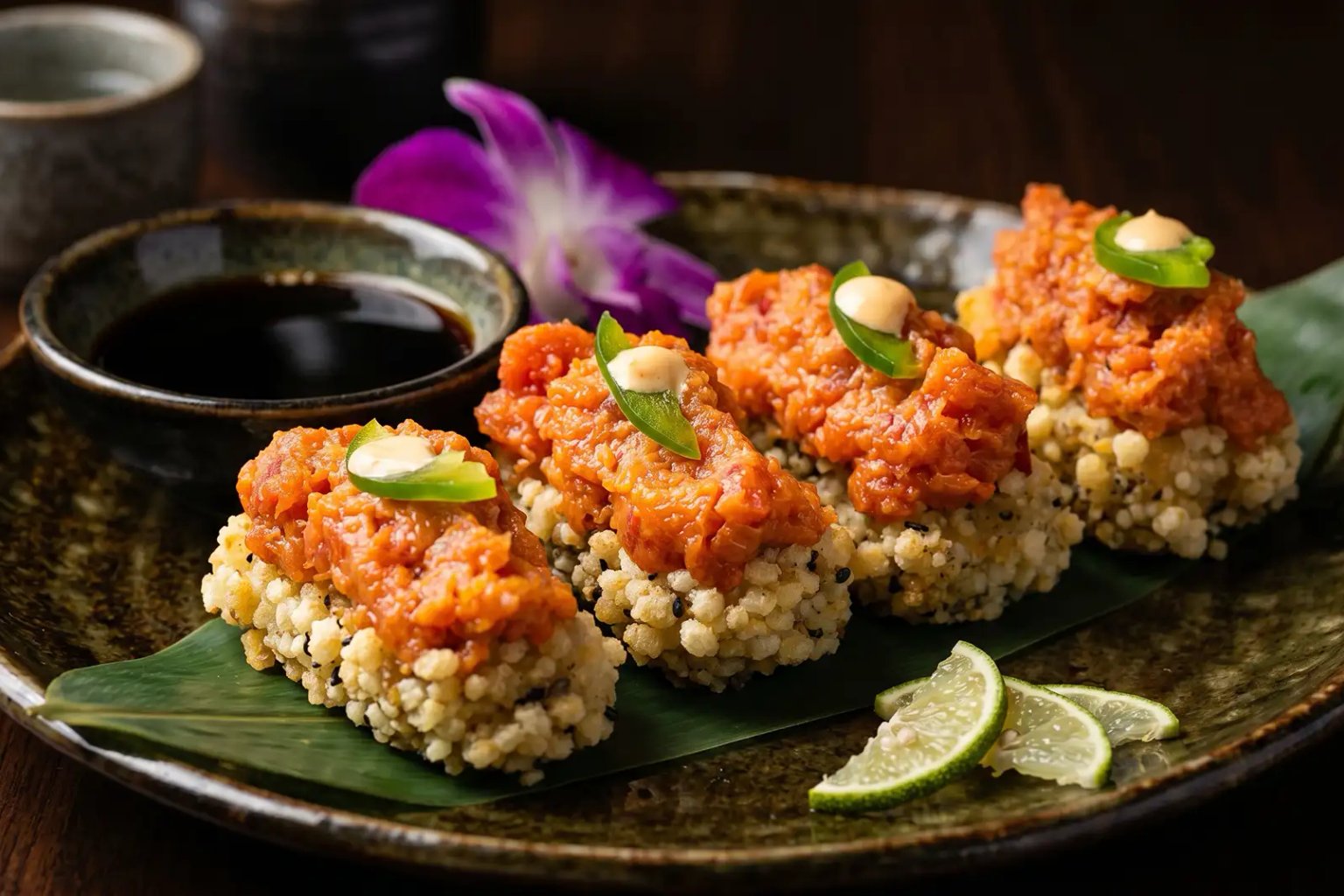
He created the dish in the late 1990s at Katsu-Ya, his small restaurant in Studio City. The pairing was not obvious at the time. Sushi rice was meant to be soft, sticky, and room temperature. Tuna was meant to be pristine, unmarred by heat or heavy seasoning. Spicy mayo was still a novelty ingredient, imported from kaiten conveyor belt bars in Japan where it was used sparingly. Uechi put them together anyway: pan-fried rice cakes, crisp on the outside and tender within, topped with finely chopped tuna mixed with spicy mayo and finished with a thin slice of jalapeño. The dish was textural, immediate, and addictive. It became a sensation and has since appeared on menus across Los Angeles, New York, Miami, and every city where high-low Japanese fusion is taken seriously.
Uechi trained in Tokyo under traditional masters before moving to Los Angeles in the 1980s. He worked his way through hotel kitchens and eventually opened Katsu-Ya in 1997. His cooking was precise and inventive without being showy. He understood American tastes but never pandered to them. The crispy rice dish is the clearest example of that balance: it respects the raw fish, it honors the rice, and it gives diners something they did not know they wanted. It also revealed something about the way food culture was shifting at the time. Sushi in America was no longer just about authenticity or reverence for Japanese tradition. It was becoming a platform for experimentation, and Uechi was one of the chefs who made that shift possible without losing integrity.
The dish arrived at a moment when celebrity chefs were beginning to dominate American dining culture. Nobu Matsuhisa had already opened Matsuhisa in Beverly Hills in 1987 and Nobu in New York in 1994, bringing his own fusion sensibility to a global audience. But while Nobu became a brand empire, Uechi remained rooted in Studio City, refining his craft without chasing the spotlight. His approach was different. He was not interested in redefining Japanese cuisine for Western palates in the way that French chefs like Jean-Georges Vongerichten had done with Asian ingredients in the 1990s. He was interested in making food that people wanted to eat again.
In the mid-2000s, Uechi partnered with nightlife developer Sam Nazarian to expand Katsuya into a restaurant group. The brand grew into multiple locations, each designed with dark wood, amber lighting, and the kind of studied cool that defined LA dining in that era. Philippe Starck was brought in to design some of the interiors, lending the restaurants a sleek, minimal aesthetic that felt aspirational without being alienating. Some food critics dismissed the expansion as a dilution of the original vision. But the original Studio City location stayed open, and Uechi continued to cook there until recently. He was not interested in becoming a television personality or a global ambassador for Japanese cuisine. He was interested in precision, in balance, in the small details that make a dish work.
His legacy is not just one dish. It is the idea that tradition and invention are not opposites — they are tools, and a good chef knows when to use each one.
Enjoyed this? Subscribe to our newsletter.